
Edmonton Needs a private tree bylaw
Update on Efforts to Advance a Private Tree Bylaw and a Call to Action
IT DOES NOT TAKE MUCh to Help save our trees
Take a minute to write a simple letter to city hall decision makers using one address
Example:
Dear Clerk, Can you please share this letter with all decision makers?
Dear Council and Mayor, I fully support a strong Public Tree Bylaw. It is estimated that 60-65% of our canopy trees are on private land, and we are falling short of our canopy goal of 20% coverage. Current data points to 13% coverage and falling. Add your Name/Ward/Postal Code
History and Updated Rationale
After years of ERVCC advocacy, on February 18th, Mayor Knack moved for the administration to return with a draft private tree bylaw. The motion was carried 11-2. This means Edmonton’s trees could finally be better protected. Please read this beautifully written article from a long-time city planner to understand how trees build a connected city. You can also access the article directly without going through the Journal.
(For a deeper dive, see here for news, as well as the agenda, minutes, and video from the Edmonton Urban Planning Committee that led up to the Motion by Mayor Andrew Knack made on Feb. 18th.)
We need to keep up the pressure on the council and administration because, sadly, the administration has recommended against implementing a private tree bylaw. Notably, the administration’s report included no supporting data, no jurisdictional scan of comparable cities, and no cost–benefit analysis. We are therefore appreciative of Mayor Knack’s motion and the support of most of the council; now they need to know we strongly support them.
Concern about the loss of mature trees in Edmonton has been growing. Early indicators suggest we are not on track to meet our modest tree canopy goal of 20% by 2071. We are very worried that the latest data showed a negative trend, moving from 13% coverage to slightly less. Given what we have all witnessed lately, it will be interesting to see the 2025 lidar data that has not yet been released. Residents bear witness to properties being clear-cut by developers before development permits are issued and before the building footprint is known. The current state of affairs allows little consideration for tree retention.
The best of Edmonton’s arborists are on side. They note that all too often, offshore and even local landholders try to employ them to clear-cut properties before they have a development permit.
Drs S. Agrawal and N. Welegedara from the University of Alberta have done useful research evaluating the urban heat island effect in Edmonton. Their research indicates that we have a cooler city south of the river in places where trees are better preserved because of better ravine and river valley tree protection. In 2025, they obtained a grant for further research with their community partner, ERVCC. Their new research data, as of 2019, shows that likely nearly 60-65 % of trees are on private land
Note: The data below was derived using 2019 LiDAR data combined with publicly available orthorectified images provided by the City of Edmonton. Additionally, they have included only trees that are taller than 3 metres. Dr. N. Welegedara and Dr. S. Agrawal employed machine learning and various algorithms for this process. Please note that their assessment is an estimation based on an aerial perspective. There are uncertainties associated with both the data and the algorithms used, as well as natural factors. For example, when two trees are very close together, they may appear to share a single canopy, making it challenging to differentiate between them. So the values are estimates with an accuracy exceeding 85%.
Another important note regarding the research findings below is that the data includes trees in the river valley. The public trees on the map below are maintained by the City of Edmonton or are located on Alberta public land (Real Property Governance Land Parcels). The researchers couldn't obtain land-ownership data in the Rivervalley; they couldn't distinguish between private and public areas. Therefore, where the graph below says 75% of Edmonton’s trees are on private land, the reasearchers note that a more realistic estimate is that private trees make up around 60-65%.
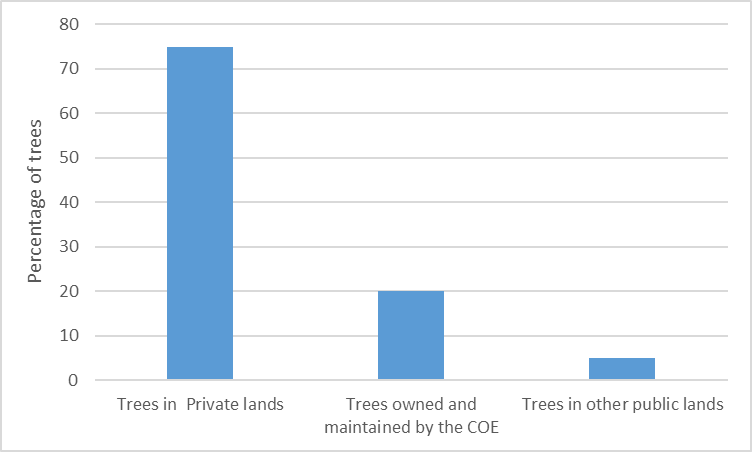
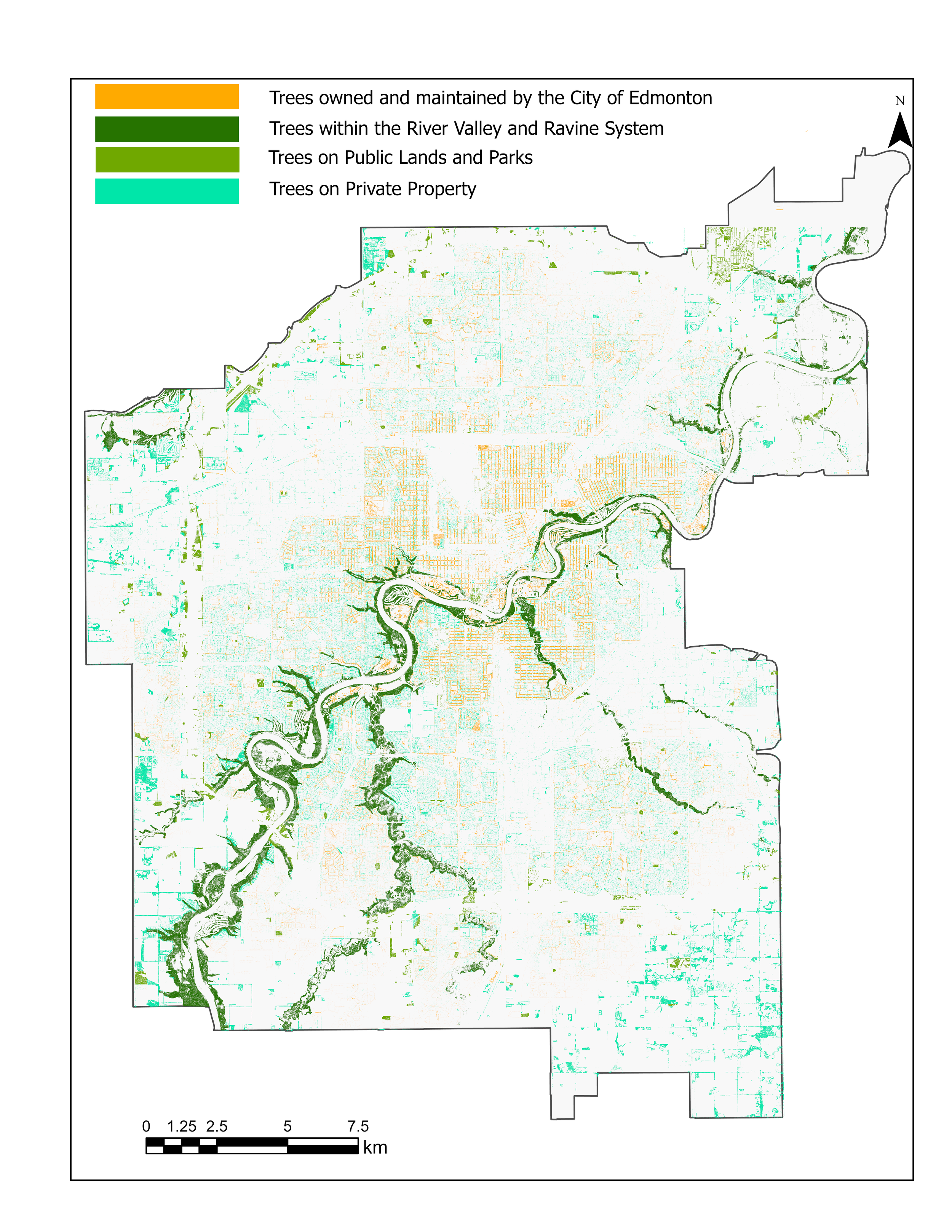
Above research provided by Drs N Welegedara and S Agrawal
ERVCC has done jurisdictional scans and interviews in BC’s lower mainland, Victoria, and Barrie, Ontario. We note that most major cities in Canada have a private tree bylaw, and the trend is to strengthen these bylaws because they are proving helpful for cost-effectively achieving urban canopy goals. The program administrators we spoke to said preserving trees on private land encountered some resistance at first, but soon just became a universally accepted way of doing business. They said the program was not difficult to administer and was structured such that one department administered landscaping compliance and the Private Tree bylaw.
Municipalities in British Columbia’s lower mainland (and Victoria and Nanaimo) all have bylaws that protect trees on public and private land. This includes Vancouver, New Westminster, Surrey, Delta, White Rock, Richmond, Coquitlam, Port Coquitlam, Langley, Abbotsford, North Vancouver, West Vancouver, Burnaby, Port Moody and Maple Ridge. Most have been in place for a decade or more.
Each municipal bylaw is slightly different than its neighbour’s, but common to each bylaw is the notion that urban canopy is of enough importance that it should be regulated. One sees phrases such as, "and whereas Council considers it is in the public interest to provide for the protection and preservation of trees,” or “a bylaw to manage the urban forest and tree canopy and regulate, prohibit and impose requirements in relation to tree cutting and removal….” One engagement report leads with "Port Moody’s trees are an important community resource, integral to the health and well-being of our people, plants, and animals – and to the city’s resilience in the face of climate change.”
Some bylaws are more lenient than others. Of course, the bylaws only apply to trees above a certain diameter (20-30 cm is most common), and exemptions exist for hazardous trees, or trees within a development footprint.
A private tree bylaw is an opportunity to retain trees and preserve the beauty, comfort, and vital ecosystem services they provide. Cost-benefit analysis shows that the value of trees outweighs the smaller costs of administering the program. Bylaws ensure that trees over a certain trunk diameter (usually 20-30 cm) are protected, and a permit is required to remove them. Permit fees help offset administrative costs. As well, citizens are able to help with enforcement. They are the eyes on the street. The timing of an Edmonton tree bylaw is ideal because a new zoning bylaw has just been put in place. Together, they can work to achieve our density, as well as our canopy goals. Recently, the City Administration has been charged with ensuring better landscaping compliance. Most large cities put landscaping compliance and private tree bylaw administration into one working group. The City of Edmonton can benefit from the learning curve of other cities in designing our bylaw.
Nature Canada’s Tree Equity program notes that we must incentivize tree planting on private land. Since a large part of the urban tree canopy is not found on public land, cities need to encourage private landowners to pitch in. A private tree bylaw ensures we will retain some mature and healthy trees.
ERVCC previously wrote this letter to decision makers outlining the issues with support from Nature Canada.
Please consider writing all decision makers now asking for a strong Private Tree Bylaw.
Please support Shrubsciber and the Secret Long Tree Society, Nature Canada and Nature Alberta
ERVCC would like to acknowledge and point to the work of Shrubscriber, Nature Alberta and Nature Canada. These groups are key supporters of a private tree bylaw, and have either informed, supported or collaborated on our work. Shrubscriber has done great work on the urban tree canopy and the heat island effect. Watch their YouTube video here. Taproot Edmonton has also done a tight summary of the issues here.

Dustin Bajer supplied
As we work towards a private tree bylaw we can also support programs for tree planting in our city.
Here are the links to current City of Edmonton programs:
The city is currently updating its Urban Forestry Management plan. Now is a good time to ensure a private tree bylaw is in place to help us retain large mature and healthy trees.